
Water Quality Guide
Not all tap water is created equal. From hardness and limescale to chlorine and contaminants, understanding what's in your water is the first step to improving it.
Shop Filters


How We Got Here
The state of UK water is increasingly difficult to defend from both a public health and infrastructure perspective. Since the privatisation of water utilities under Privatisation of water in England and Wales, companies have operated under a shareholder-driven model that has prioritised financial extraction over long-term system resilience. The result is ageing infrastructure, chronic underinvestment, and repeated failures in wastewater management - evidenced by rising sewage discharges into rivers and coastal waters. Investigations and public scrutiny, including narratives explored in the documentary Dirty Business, highlight systemic issues: excessive executive pay, high debt loading, and regulatory frameworks that have failed to enforce meaningful accountability.
From a biological and environmental standpoint, this translates into greater variability in water quality, increased chemical treatment reliance, and a growing disconnect between what is technically “compliant” and what is genuinely optimal for human health.
What makes water hard or soft?
Water hardness is determined by the concentration of dissolved minerals, primarily calcium and magnesium. As rainwater passes through rock and soil, it picks up these minerals. The type of geology in your area dictates whether your water is hard or soft. Soft water tends to be less thirst quenching than hard water but this depends on your individual preferences.
Since our water filter system retains minerals (but captures larger particles such as calcite), it does not work as a softener which are used to reduce limescale build up. Some of our customers use water softeners for their household mains and keep the drinking water tap free from softened water.
What does TDS refer to in water?
Total Dissolved Solids (TDS) is a simple way of describing how much “stuff” is dissolved in your water. This includes naturally occurring minerals like calcium and magnesium, as well as salts and small amounts of organic matter. TDS is usually measured in parts per million (ppm), and most home devices estimate it by checking how well the water conducts electricity - more dissolved particles means higher conductivity. In everyday terms, a higher TDS reading often means the water contains more minerals, not contaminants.
The key limitation is that TDS doesn’t tell you what is in the water - only how much is there in total. It can’t distinguish between beneficial minerals and harmful substances like heavy metals, chemical pollutants, or bacteria. Water can show a “low” reading and still be poor quality. Equally, water with a higher TDS isn’t necessarily bad - it may just be naturally rich in minerals.

What about flouride?
Fluoride is a naturally occurring mineral found in soil, rock, and water, typically present as the fluoride ion such as calcium flouride. At low levels, it can contribute to enamel remineralisation by forming fluorapatite. Natural fluoride enters water supplies through geological leaching, so concentrations vary widely depending on local rock composition. This type of flouride is not something you should be worried about due to its low solubility.
Synthetic flouride (such as Fluorosilicic acid) has a higher solubility but it is not added to the the vast majority of the UK drinking water, including much of the South and South West. Our system removes approximately 13% of flouride currently as flouride is treated like a mineral by the filter. In the UK, the majority of fluoride intake typically comes from food and beverages (for example tea) rather than drinking water.
Microplastics in tap water
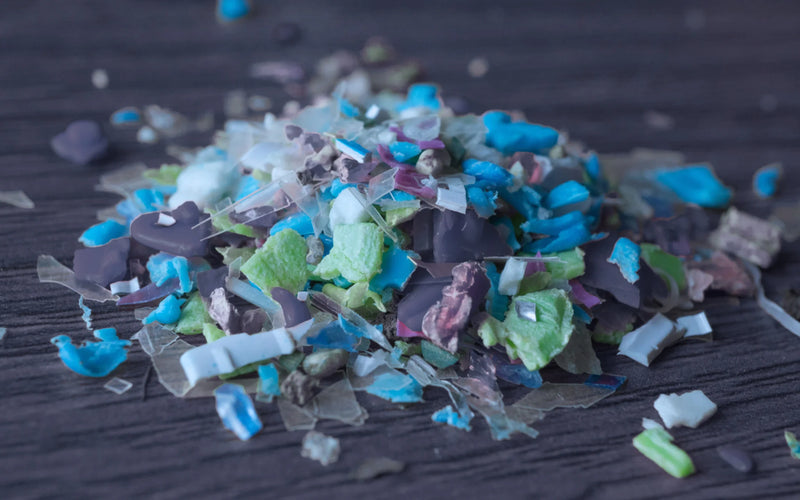
Micro and nanoplastics are now commonly found in UK tap water due to the breakdown of plastic waste in the environment. Over time, plastics from packaging, clothing, tyres, and other sources fragment into tiny particles that enter rivers and reservoirs. Despite modern treatment, studies analysing UK tap water samples across multiple cities have found microplastics present in 100% of samples, typically ranging from ~6–100 particles per litre.
Our system removes these particles using both physical filtration and charge-based capture. The microspiral structure helps trap particles as water flows through, while the positively charged filter attracts and binds even very small particles that would otherwise slip through such as nanoplastics.
Key Facts About UK Water
What the research says about what's coming through your taps.
Microplastics
Found in every UK tap water sample tested. Too small for standard municipal filters to capture.
PFAS Chemicals
"Forever chemicals" detected in water supplies serving millions of UK residents. They never break down.
Heavy Metals
Lead pipes remain in roughly 30% of UK properties and continues to be a problem for rural areas.
Chlorine Byproducts
Trihalomethanes form when chlorine reacts with organic matter. Linked to health risks with daily exposure.
VOCs
Volatile organic compounds (VOCs) are emitted as gases from certain solids or liquids.
Pesticides
Residues From industrial farming such Metazachlor or Glyphosate.
Water Hardness by Region
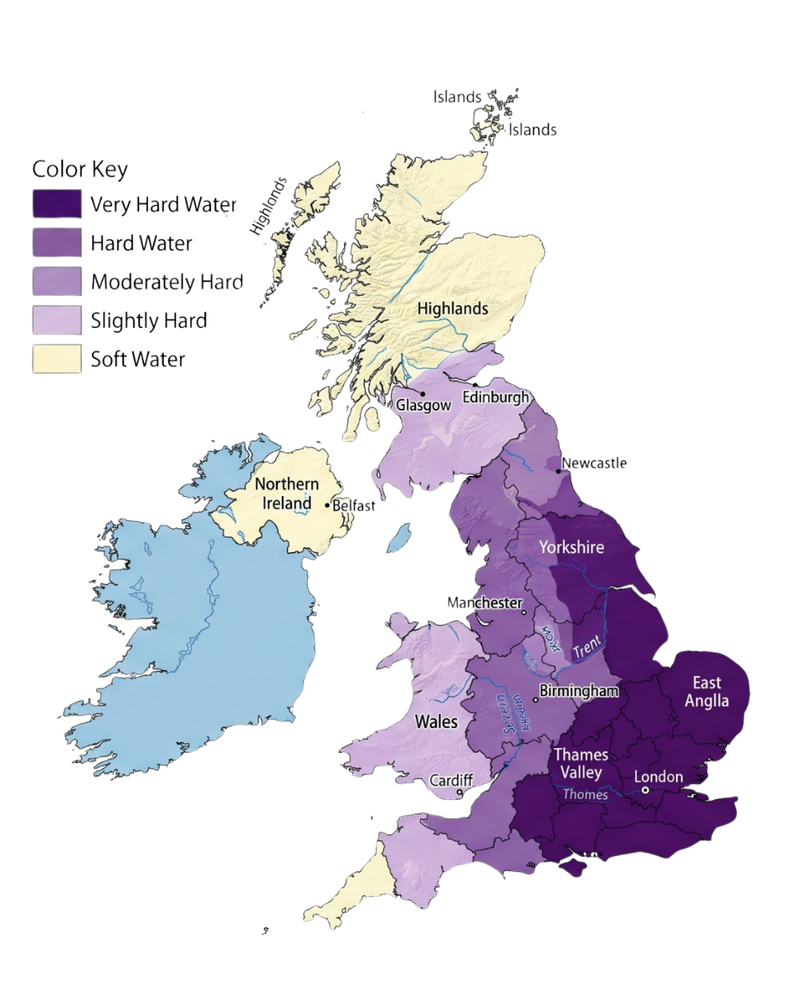
UK water hardness varies dramatically depending on where you live. The map shows the general pattern: southern and eastern England tends to have very hard water, while Scotland, Wales, and the north-west are predominantly soft water areas.
South East England
Very hard water. High calcium and magnesium from chalk and limestone geology. Heavy limescale buildup is common. London, Kent, Surrey, and Sussex are particularly affected.
Midlands & East Anglia
Hard to very hard water. Similar geological factors with additional agricultural runoff concerns. Limescale protection is particularly valuable in these regions.
North West & North East
Moderately soft to moderate. Generally lower mineral content due to gritstone and slate geology. Chlorine taste tends to be the primary concern here.
Scotland & Wales
Predominantly soft water from granite and ignite rock formations. While limescale is less of an issue, chlorine treatment and ageing pipe infrastructure still affect quality.
Better Water Starts Here
Now that you understand what's in your water, explore how ClearSpiral's multi-stage filtration removes what shouldn't be there while preserving what should.